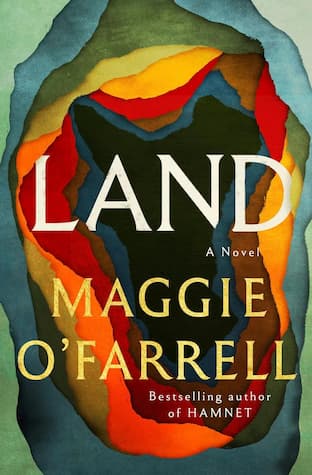
Land by Maggie O'Farrell
Published by Alfred A. Knopf
Publication date: June 2, 2026
Genres: Book Clubs, Fiction, Historical, Literary

Bookshop
One family and a country wiped out by famine are the heart and soul of Land, Maggie O’Farrell’s sweeping new novel. The lives of Tomás, Phina, and their children, Liam, Enda, Rose, and Eugene play out on the page with all the verdant vibrancy of the land they love.
It’s a decade after the Great Hunger in Ireland and Tomás has found much needed work as a cartographer for the British. His 10-year-old son Liam helps with the surveying of these trips that traverse Ireland, redrawing its topography, as entire villages are gone, abandoned. It’s dispiriting work, but Tomás is a man who believes in the importance of lines, degrees, and numbers and he must keep his family fed. Until he disappears for days into a small copse of woods on the island’s southernmost tip and returns so changed the trajectory of his family is altered as well. This small grove of trees holds the mystical axis from which Land sprawls backwards and forwards between Ireland’s original inhabitants and the lives of Tomas and Phina’s children.
Heart-wrenching and atmospheric from its opening pages, O’Farrell ignores the conventional boundaries between one character’s story and the next. Rather than clearly dividing chapters or announcing a new point of view, she lets the narrative drift almost imperceptibly from one life to another. It feels less like a break than a shift of the eye, following one thread until it naturally catches another, even across an ocean. With another writer, I might have found it jarring to be pulled from one character’s mind into another’s in the space of a paragraph. Here, it feels entirely organic.
That choice also serves a larger purpose. Many novelists would bend the story to satisfy the reader’s desire for closure, but O’Farrell resists that temptation. Instead, she honors the reality of the more than one million people who left Ireland’s villages and farms for the crowded cities of North America, knowing they would never see home—or one another—again. She captures not only the heartbreak of leaving the land of your birth, the soil you know, but also the cavern of isolation it creates inside—a cold, lonely place filled with echoes of the people and places you had to leave behind.
Tidy conclusions are not part of the journey. O’Farrell’s novels simply end when they’ve reached the place they need to, leaving readers with images that are beautiful, haunting, and often unresolved. Land is no exception. Layered with mysticism, the abiding beauty of nature, and the quiet chaos of human lives, it carries a sense of loss from beginning to end. As each character’s story reaches its natural conclusion, there is the possibility of solace, perhaps even joy, but the novel turns away from it. Rather than offering closure, it embraces the randomness of a single moment, leaving both its characters and the reader with sorrow. It felt almost cruel, even if it was emotionally honest. I longed for a single grace note before the final elegiac page.
I’m a huge fan of O’Farrell. If you like Irish writing you should try Hamnet and Instructions for a Heat Wave two of her other books I loved.
This post contains affiliate links which means if you click on a link and make a purchase, I get a small commission (at no cost to you).
*I received a free copy of this book from Knopf in exchange for an honest review.*





Oh wow. I just finished this last night and then found your review. I generally seem to track with you on things.
I enjoyed the read, and she is such a beautiful writer. I felt it lost me a bit at about 75-80% and found myself doing some skimming which was partly due to the fact I need to get it back to the library. There is SO much to think about with this book. Moreso than Hamnet (I think) this book put you in a place (Ireland). Because this book is all about the Land!
I would agree I liked Hamnet better, was it shorter? This book does SO much, perhaps too much. But wow, I learned a lot.
Agreed. Hamnet was 5 stars for me. This was only 4.5. It is much longer and covers so much more space. That plus the ending. Why couldn’t she let there be one happy reunion?