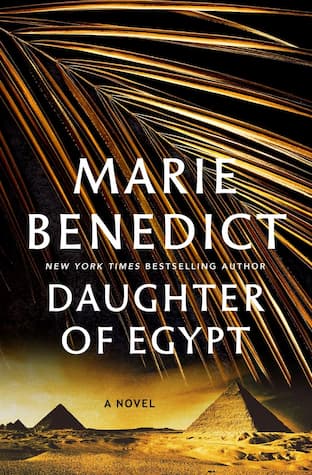
Daughter of Egypt by Marie Benedict
Published by St. Martin's
Publication date: March 24, 2026
Genres: Fiction, Historical

Bookshop
Two young women, separated by thousands of years, stand at the center of Marie Benedict’s new novel, Daughter of Egypt. One is the daughter of a wealthy English lord in post-WWI England while the other is a pharaoh’s daughter in ancient Egypt. Only one has a life predestined by the gods, but both will have to fight to live the life they believe should be theirs.
Evelyn Herbert has been fascinated by her father, Lord Carnarvon’s, obsession with ancient Egypt from the time she was a little girl. She spent hours in her father’s library absorbing everything he and Howard Carter, the archaeologist he employed, discussed about their expeditions to Egypt’s Valley of the Kings. Now she’s a young woman and while her father hopes to discover an intact pharaonic tomb, possibly of the famed Tutankhamen, her research has bred in her a fervent desire to go to Egypt with him in pursuit of a pharaoh long forgotten. Unfortunately, she’s now of marriageable age and her mother presses her hard on her one and only duty as a good daughter, to marry well. Something she has no interest in.
Hatshepsut is the daughter of Thutmose I. In accordance to the dynastic laws she was married to a half-brother, who became pharaoh. Upon his death, the next male heir was only two years old so she became regent to rule Egypt until he came of age. In Daughter of Egypt we watch as her leadership evolved to the point of ruling the country alone as she quietly assumed the role of pharaoh, going so far as to appear in traditional male pharaonic attire. She led Egypt into decades of peace and prosperity, but unlike her predecessors every mention of her name and reign was erased from history.
As Benedict excavates the centuries that lie between Evelyn and Hatshepsut she unearths the similarities between the two, from filial expectations and patriarchal cultures to personal drive and inner strength. Both are impacted by Egypt’s history as a fractured nation with Hatshepsut is trying to bring the warring Lower Egypt and Upper Egypt together while Eve’s expedition hopes are impacted by the political violence in Egypt in the 1920s as it sought political independence from the British.
Each of the ingredients in Daughter of Egypt complements the others as they come together in this diverting novel about the roles of women in history. It is a fact that Hatshepsut’s name and likeness was removed from all public structures and her statues demolished. There is a historically accepted explanation, but Benedict closes Daughter of Egypt with an alternative theory, something I had mixed feelings about. It felt either completely plausible or like a bit of apologia for actual events. Either way, it provides another talking point about one of the few female rulers in Egypt’s long history of dynastic rule.
Benedict has written several novels about women in history. One of my favorites is The Personal Librarian.
I am an affiliate of Bookshop.org where your purchases support local bookstores. I will earn a commission (at no cost to you) if you click through and make a purchase.
*I received a free copy of this book from St. Martin’s Press in exchange for an honest review.*














Leave a Reply